
Case study
WELL certification for buildings: How IoT can help
Julie Sylvest

What is the WELL Building Standard?
The WELL Building Standard, administered by the International WELL Building Institute (IWBI), puts occupants’ health and well-being at the center of the building design and operations.
Unlike traditional sustainability benchmarks that focus purely on energy efficiency or carbon footprints, WELL v2 certifies physical spaces across ten core concepts: air, water, nourishment, light, movement, thermal comfort, sound, materials, mind, and community. Projects earn points across these categories to achieve Bronze, Silver, Gold, or Platinum status.
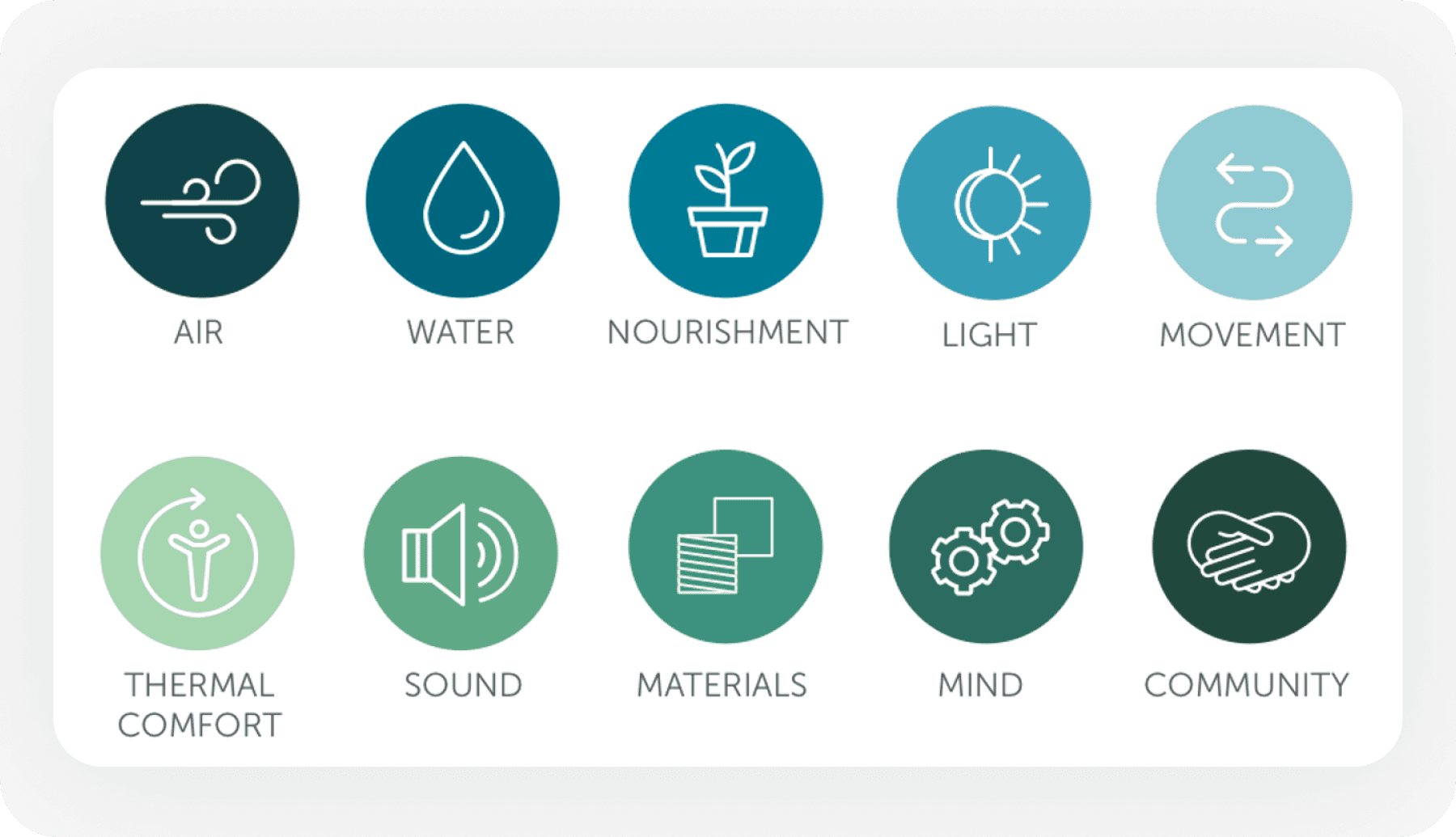
Image source: International WELL Building Institute (IWBI)
WELL certification isn't a one-and-done exercise. It is built around ongoing performance. Because recertification is required every three years, building operators must prove that indoor environmental quality is optimal day in and day out.
How IoT Supports WELL
Without IoT, building certifications rely on manual testing—capturing a single snapshot in time that quickly becomes outdated. Because WELL features require verified performance, continuous monitoring provides the ongoing data necessary to maintain your rating.
Recertification every three years shouldn't mean scrambling for stressful audits. With akenza, continuous IoT monitoring keeps your building audit-ready.
It starts with hardware that seamlessly integrates with your infrastructure, and comes together in dashboards that turn data into insights.
Hardware that gives you evidence
The akenza Device Type Library features over 400 pre-configured devices to ensure you can deploy your IoT project without delay. New sensors are constantly added to the platform, and you can easily create your own custom device types.
For instance, the inBiot MICA WELL is built for indoor environmental health monitoring. It measures 12 key parameters, including PM, CO₂, and O₃. Its LED light automatically reflects real-time ventilation requirements. Engineered specifically to meet certification standards, it helps secure additional WELL points. akenza supports other leading sensors such as the Synetica enLinkIAQ and Miromico miro Insight for precision air quality tracking and Milesight’s AM308 and AM319 for ambient monitoring. No matter which hardware you deploy, akenza brings sensor data to life on customizable dashboards.
Turning data into awareness with the Dashboard Builder
The akenza Dashboard Builder makes data transparent for compliance as well as to the people occupying the space.
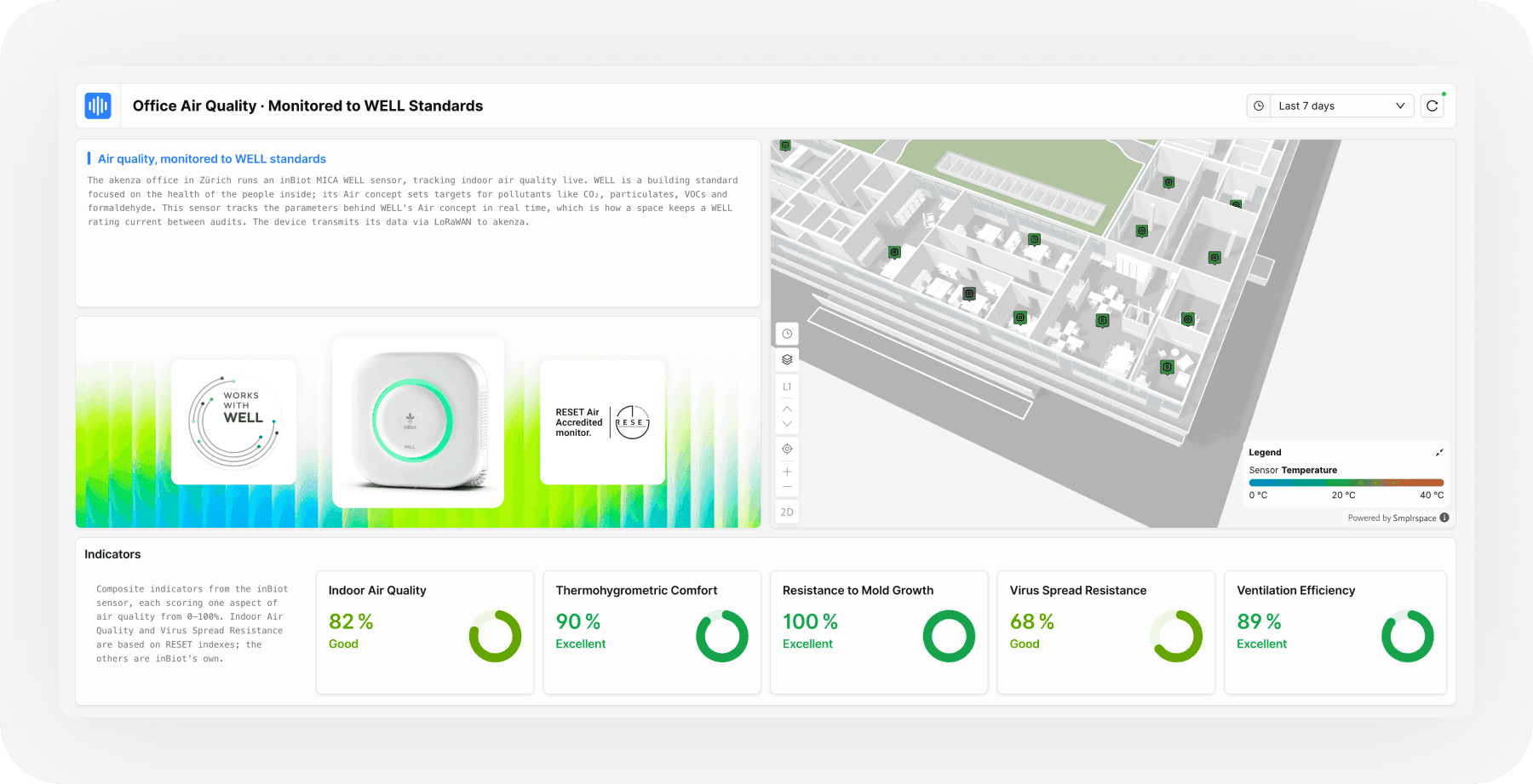
With the Dashboard Builder, building managers can configure and deploy custom views in minutes using no-code, drag-and-drop components. It’s easy to build dashboards with current and historic data to prove long-term compliance, set up public signage screens to display real-time metrics, or send sensor data into central management tools.
Analytics in the tools you already use
Output connectors let you analyze WELL data in your existing IT environment. They forward structured sensor data to SQL databases (PostgreSQL, MS SQL, MySQL), data warehouses like Snowflake, and BI tools such as Power BI and Tableau. The same feed powering your WELL dashboard can also drive internal reporting and ESG documentation.
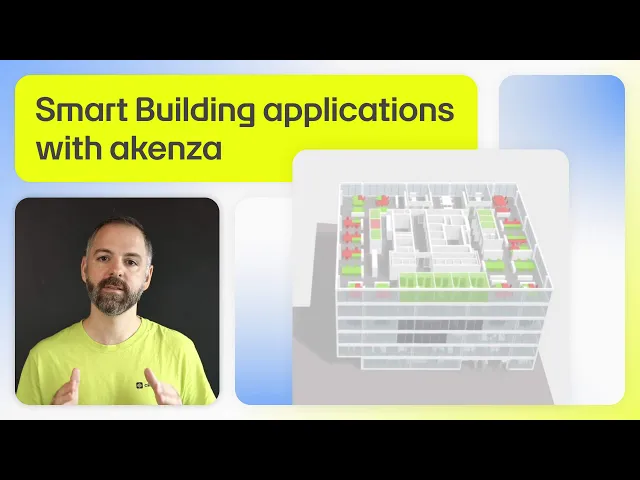
See it in action. For a deeper look into how continuous monitoring powers smart building applications, watch our YouTube video.
Discover more blog posts


Need help with your IoT project?
To learn more about how akenza can help you build smart solutions with ease, contact us or directly sign up for a free trial today.
Changelog
If you want to follow the latest updates and upcoming features of akenza in real-time, be sure to check our changelog.