
Case study
What Is an IoT Application Enablement Platform (AEP)?
Alexis Leibbrandt
Building IoT from scratch is a waste of time and money. You need device connectivity, a decoder for your sensor payload, a data pipeline and storage, configurable logic to trigger alerts, and a front-end to surface it to your users. That is five different problems before you have shipped a single use case.
An IoT Application Enablement Platform (AEP) solves all of them in one place. It is the software layer between your physical devices and the decisions your business needs to make.
What Is an IoT Application Enablement Platform?
An IoT Application Enablement Platform is a software platform that provides the full stack of tools needed to connect IoT devices, process their data, apply business logic, and surface insights through dashboards or external integrations. All without requiring organisations to build and maintain that infrastructure themselves.
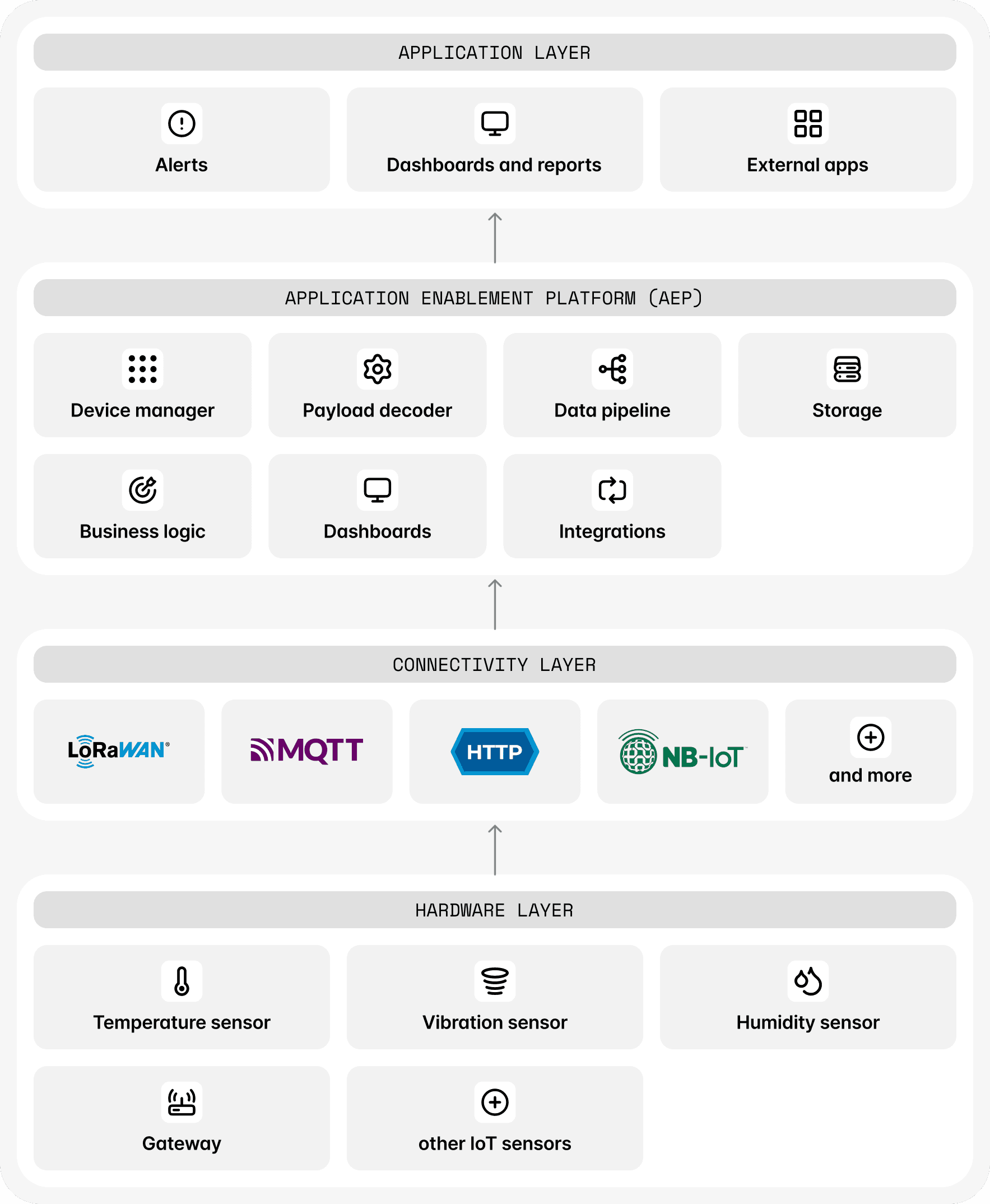
AEPs are typically delivered as SaaS and are designed to be used by technical teams who want to focus on the use case, not the plumbing. They sit between the physical hardware layer (sensors, gateways, network) and the application layer (dashboards, alerts, apps).
AEPs vs. other types of platforms
The IoT platform market is noisy and the terminology is inconsistent. Here is how an AEP differs from the other main platform types you will encounter:
Device management platforms
Device Management-only Platforms focus on provisioning, configuring, and monitoring devices at scale. They are about managing the fleet, not what you do with the data. An AEP usually includes device management as one layer of a broader stack.
Connectivity management platforms
These handle the network layer: SIM management, data plans, roaming, protocol routing. In LoRaWAN deployments specifically, this also extends to gateway management, provisioning, monitoring, and maintaining the gateways that bridge your devices to the network server. Again, an AEP typically integrates with connectivity management rather than replacing it.
Cloud IoT services (AWS IoT, Azure IoT Hub, Google Cloud IoT)
Hyperscaler IoT services offer powerful, enterprise-grade infrastructure with virtually unlimited scale. They do require significant technical expertise to set up and operate, and are best suited for teams with dedicated engineering resources. An AEP abstracts that complexity so that broader teams can also operate IoT deployments. For organisations already invested in a hyperscaler ecosystem, a good AEP will let you forward data directly to AWS IoT, Azure IoT Hub, or Google Cloud IoT as part of your pipeline.
The core components of an AEP
The exact feature set varies by vendor, but a well-built AEP covers at minimum:
Device and connectivity management: onboard, configure, and monitor your device fleet across multiple protocols and network providers.
Data processing: define how incoming data is decoded, routed, and stored, if possible, fully in no-code.
Business logic: trigger actions based on sensor data, such as alerts or downlinks to other devices.
Data storage: time-series storage built for IoT data volumes, with the option to forward data to external databases or cloud services.
Visualisation: charts and dashboards to display device data, often shareable externally.
APIs and integrations: REST APIs and connectors to enterprise systems, cloud services, and BI tools so the data flows where it is needed.
The best AEPs also add multi-tenancy for organisations managing multiple clients or workspaces, white labeling for system integrators who want to deliver branded solutions, and deployment flexibility so enterprises can run on a dedicated cloud instance rather than shared SaaS.
How to evaluate an IoT AEP: 5 questions to ask
Not all AEPs are equal. Here is what actually separates the strong platforms from the ones that will slow you down:
1. How broad is the protocol and connectivity support?
If your device mix isn’t homogeneous, you will need an AEP that supports multiple connectivity technologies, such as LoRaWAN, mioty, HTTP, MQTT, NB-IoT, and others, out of the box. Check whether the platform also supports Connectivity-as-a-Service, so you can onboard devices without a separate network operator contract.
2. Can non-developers operate it independently?
The whole point of an AEP is to reduce dependency on development resources and be able to build your own application fast. If your facilities team or IoT solutions engineer needs a developer for every rule or dashboard change, it is not delivering on that promise. Look for true no-code data flows, a drag-and-drop dashboard builder, and logic blocks that do not require extensive programming.
3. What are the deployment and data sovereignty options?
For enterprise buyers, shared cloud SaaS is not always acceptable. Regulated industries, government clients, and organisations with strict data residency requirements need a dedicated instance option on their cloud provider of choice. ISO 27001 certification and GDPR compliance should be baseline requirements.
4. How does it scale from PoC to production?
Starting a proof of concept is easy. The risk is getting locked into a platform that cannot scale gracefully. Look for bulk device management and a pricing model that does not punish you for success.
akenza gives you the full AEP stack
akenza was designed from the ground up as an IoT Application Enablement Platform. Every component in the stack exists to reduce the distance between a connected device and an actionable outcome.
Here is what that looks like in practice:
Device and connectivity management covers LoRaWAN, HTTP, MQTT, CoAP, NB-IoT, and Mioty. Bi-directional sync with major LoRaWAN network servers makes it easy to register a device and manage your fleet in one place.
Data Flows are the no-code pipeline that defines how data moves from device to output. Select a device connector, a device type with the right payload decoder, and one or more output connectors. Done.
The Rule Engine handles real-time business logic: threshold alerts, geofence checks, timed rules, custom JavaScript blocks. Actions include SMS, email, Slack, Microsoft Teams, webhooks, and downlinks to the device.
The Dashboard Builder produces fully customizable, shareable dashboards with no code. Maps, time-series charts, KPI cards, floorplan overlays, and downlink control components are all available out of the box.
Enterprise readiness includes ISO 27001 certification, 2FA, SSO, full audit logs, white labeling, multi-tenancy, and dedicated cloud instance deployment on Azure, AWS, or GCP.
akenza was also included in the MachNation IoT AEP ScoreCard alongside Amazon, Google, IBM, Microsoft, Siemens, and PTC.
Start building today
akenza offers a 30-day trial. You can connect your first device, build a data flow, set up a rule, and publish a dashboard in an afternoon. See it in action.
Discover more blog posts


Need help with your IoT project?
To learn more about how akenza can help you build smart solutions with ease, contact us or directly sign up for a free trial today.
Changelog
If you want to follow the latest updates and upcoming features of akenza in real-time, be sure to check our changelog.